




The duty sits with you, not the installer
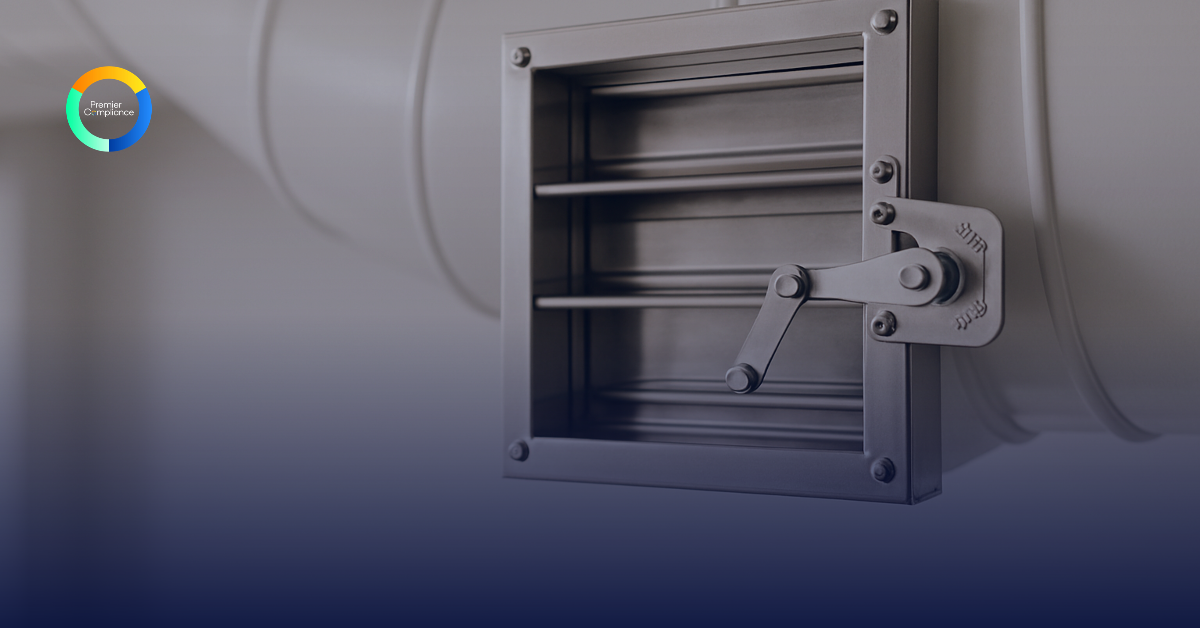
The fire damper above a communal riser has not been operated in years, and nobody can say for certain whether it still closes. That gap — between a damper that exists and a damper that works — is where legal exposure lives, and closing it is your responsibility as the Responsible Person.
Under the Regulatory Reform (Fire Safety) Order 2005, the duty to maintain fire safety measures in a building sits with the Responsible Person. In most commercial and multi-occupied residential buildings that is the employer, the owner, or whoever has control of the premises. Fire dampers are a fire safety measure. They are the components that stop fire and smoke travelling through ductwork from one fire compartment into another. If they are installed, the RRFSO requires them to be maintained in efficient working order — and "maintained" means tested and evidenced, not simply assumed to be fine because they were fitted correctly once.
The person who installed your ductwork is not the person on the hook if a damper fails. You are. That is the first thing to be clear about, because the installer's involvement usually ended years ago.
What the law requires, layer by layer
The Fire Safety (England) Regulations 2022 sharpened record-keeping and information duties, particularly for high-rise and multi-occupied residential buildings. They reinforced the expectation that fire safety measures are documented, that information is available, and that duty-holders can demonstrate what has been done rather than describe it verbally.
The Building Safety Act 2022 introduced the "golden thread" — the principle that safety-critical information about a building must be created, kept current, and be accessible throughout the building's life. For fire dampers, that means the record of what is installed, where it is, and when it was last tested is not a nice-to-have. As a statutory duty, though, the golden thread applies only to higher-risk buildings — in England, occupied buildings at least 18 metres tall or with at least seven storeys that contain at least two residential units. For those buildings, the golden thread information the accountable person must keep includes the building's fire safety measures and where they are, and records of maintenance and repairs: your damper register and test history belong there. For every other building it is not a legal requirement, but the same records are how you show the Responsible Person is keeping dampers in efficient working order.
For estates in Scotland, the equivalent duty comes through the Fire Safety (Scotland) Regulations 2006 and the associated Part 3 of the Fire (Scotland) Act 2005. The mechanism differs but the substance is the same: the duty-holder must maintain fire safety measures and be able to show it.
How often — and when annual is not enough
This is where owners most often get the wrong answer.
BS 9999 provides guidance on the management of fire safety, including the testing of fire dampers. It recommends that every fire damper is tested by a competent person on completion of the installation and at least annually after that, and that spring-operated dampers are tested annually. Dampers in dust-laden and similar atmospheres should be tested much more frequently, at intervals suited to the degree of pollution.
The practical point: annual is the floor, not the target. A blanket "we test them all once and forget it" approach will not stand up, and neither will an annual cycle for a damper sitting in a dusty or contaminated system.
Why DW/145 matters — even though it is not law
BESA's DW/145, the Guide to Good Practice for the installation of fire and smoke dampers, is exactly that: guidance, not statute. No regulation says "you must comply with DW/145." So why does it matter?
Because when something goes wrong and your maintenance regime is examined, the question is whether you acted reasonably. Recognised industry good practice is the benchmark against which "reasonable" is measured. If you followed DW/145, you can point to a published, respected standard. If you departed from it, you need a defensible reason. Guidance is not law — but ignoring guidance is difficult to justify after the fact, and "we didn't have to" is rarely an answer that survives scrutiny.
What an acceptable evidence trail looks like
A regulator, an insurer or an incoming compliance lead should be able to ask for your damper records and receive something coherent. In practice that means:
- An asset register listing every fire damper, its location, its type, and its access route.
- Per-damper test records — not a single certificate saying "dampers tested," but a record for each unit showing it was operated and that it closed and reset correctly.
- Photographic evidence capturing the condition and the test, tied to the specific damper.
- Retained documentation stored so it can be produced on request, not scattered across email inboxes or lost with a departed contractor.
One further point that catches people out: a damper is only as good as the compartment wall it sits in. If the surrounding penetration is poorly sealed, the damper's integrity is compromised regardless of whether it operates. Damper testing and compartmentation and fire stopping belong in the same conversation — testing the damper while ignoring a failed seal around it proves very little.
If you don't know your current position
Plenty of building owners genuinely cannot say when their dampers were last tested, or even how many they have. That is a common starting point, not a failure — but it is not a position to stay in.
The sensible first step is a survey to establish what you have and its condition, followed by a testing programme built around the risk profile of each installation. From there you hold an evidence trail that answers the question before anyone asks it.
If you're unsure where you stand, our fire damper testing team can establish your asset position and put a defensible programme in place.