




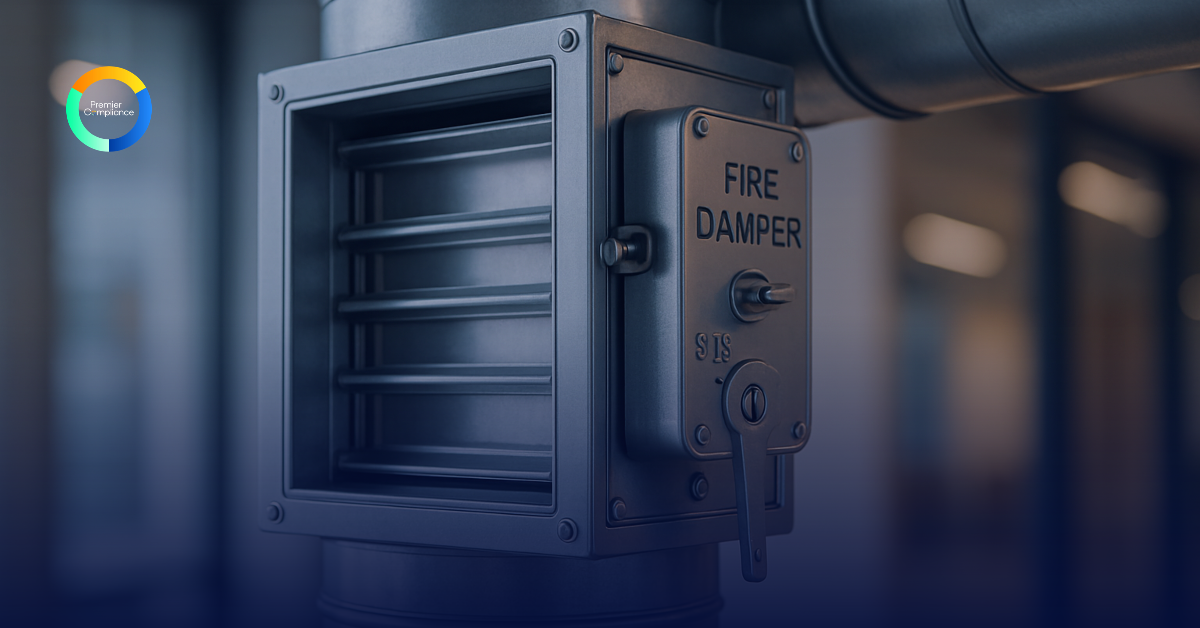
A damper you cannot reach is a damper you cannot test
The fire damper above the kitchen extract has not been tested in nine years. Not because anyone forgot, but because it was installed flush into a ductwork run with no access hatch and a suspended ceiling sealed underneath it. To inspect it, somebody now has to cut into the ceiling, find the damper, prove it operates, and make good afterwards. That single decision at installation — leaving out an access panel — turned a 20-minute test into a half-day job with a contractor and a plasterer.
But the missing hatch is the smaller defect. The bigger one is that the damper is there at all. BS 9999 says fire dampers should not be fitted in kitchen extract ductwork, so a damper above a kitchen extract run is itself the defect, whether or not anyone can reach it. Cutting a hatch will let you test it. It will not make it the right protection for that wall.
Both faults were decided on the day it was installed, and getting installation right is exactly what DW145 exists for. It is the BESA (Building Engineering Services Association) guide to good practice for the installation of fire and smoke dampers, and while it is not law in itself, it is the recognised standard your installer and your testing contractor will be working to. If you are a building owner or responsible person, you do not need to read it cover to cover. You do need to understand what it asks for, because the cost of ignoring it lands on you at maintenance time.
What DW145 actually sets out
DW145 covers how a fire or smoke damper should be installed so that it works when it is needed and can be tested when it is due. The core points are practical ones.
Access. Every damper needs a means of access for inspection, testing and cleaning. That usually means an access panel of an adequate size positioned close enough to reach the damper and its operating mechanism. A damper buried behind solid construction with no panel is, in maintenance terms, useless — you cannot prove it works.
Installation within the fire-separating element. A fire damper has to sit correctly within the wall or floor it is protecting, with the breakaway or fixing detail done to the manufacturer's instructions and the gap around it firestopped properly. A damper installed slightly out of position, or fixed in a way the manufacturer never tested, may not hold back fire even if the blade closes.
Documentation. DW145 expects the installation to be recorded — what was fitted, where, and to what specification. This feeds straight into your O&M information and the golden thread of building information that the Building Safety Act 2022 now expects you to hold.
How this connects to your legal duties
The guide is not the regulation, but it sits underneath one. Under the Regulatory Reform (Fire Safety) Order 2005, the responsible person must keep fire-resisting elements — and that includes fire dampers — in efficient working order. The widely accepted benchmark for that is annual drop testing, with the result recorded. BS 9999 reinforces the principle that fire and smoke control measures must be inspected and maintained on a planned basis.
None of that is achievable if the dampers were installed in a way that prevents access. This is where DW145 becomes your ally rather than a piece of trade paperwork. When a damper is installed to DW145, your testing contractor can get to it, operate it, reset it and document it without destructive work. When it is not, you inherit a recurring problem that gets more expensive every cycle.
A scenario worth recognising
Consider an estates manager taking over a mixed commercial block built six years ago. The fire risk assessment flags that damper testing has never been completed. The contractor surveys and reports that of 40 dampers, 28 have proper access panels and were tested without issue. The remaining 12 are inaccessible — three behind tiled bathroom walls, the rest above sealed plasterboard ceilings with no hatch.
Those 12 are now a capital problem, not a maintenance one. Each needs a panel cut and fitted before it can ever be tested, and that work has to be firestopped and recorded. Had the original installation followed DW145, every one of those dampers would have had an access route from day one. The estates manager is paying for somebody else's shortcut years after the fact.
What to do with this
Three practical steps follow.
First, if you are commissioning new ductwork or a refurbishment, write DW145 compliance into the specification and ask for installation records at handover. Do not accept a system you cannot maintain.
Second, on existing buildings, ask your fire damper testing contractor to report not just on which dampers passed, but on which dampers could not be accessed at all. That list tells you where your hidden costs are.
Third, treat access provision as part of your fire-safety budget, not an afterthought. A damper without a panel is a future invoice with a date you cannot predict.