




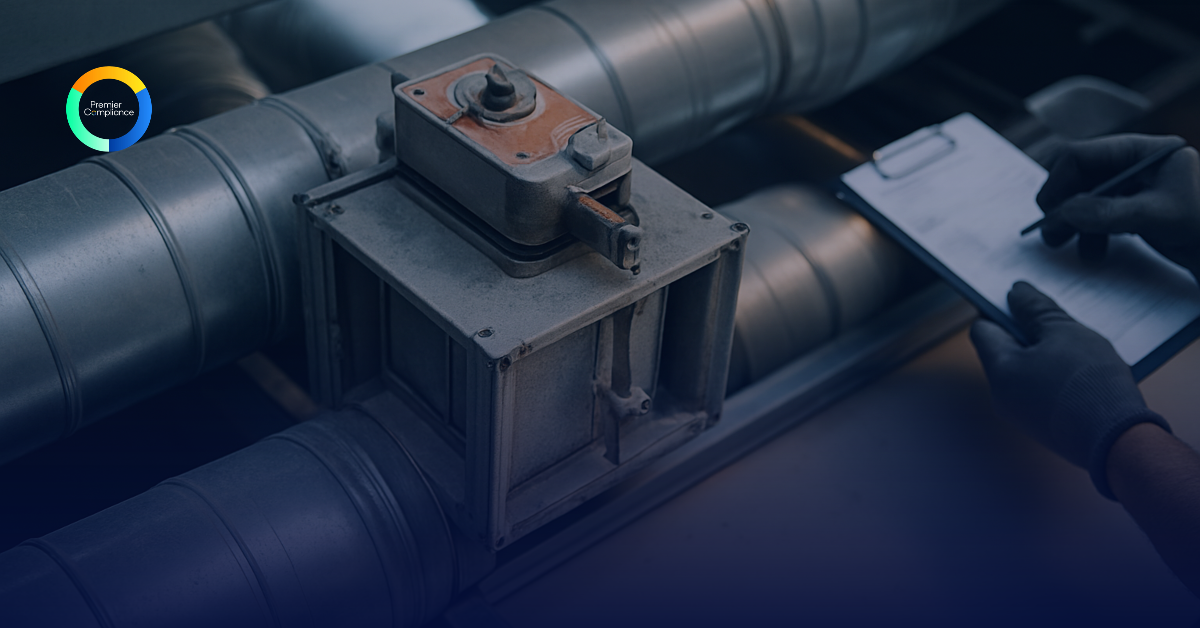
What do I need to do with my fire dampers?
Fire dampers are one of the easiest parts of a building's fire protection to forget about. They sit hidden inside ductwork, out of sight and out of mind, until an inspection or an incident brings them sharply back into focus. If you're a building owner or a responsible person, here's what you actually need to know — and do — about them.
What a fire damper is, and why it matters
A fire damper is a mechanical barrier built into your ventilation ductwork. Under normal conditions it sits open, letting air move through the system. When a fire breaks out, it closes — usually triggered by a fusible link that melts at a set temperature, or by an actuator linked to the building's fire alarm.
The point is simple: ductwork runs through walls and floors that are designed to resist fire for a set period. Without a damper, that ductwork becomes an open channel for smoke and flames to bypass the compartment walls entirely. A fire damper restores the integrity of the fire compartment. If it doesn't close when it should, the compartmentation you're relying on has a hole in it.
Your legal duty
Under the Regulatory Reform (Fire Safety) Order 2005, the responsible person must maintain the fire safety provisions in a building so they remain in efficient working order and in good repair. Fire dampers fall squarely within that duty. You can't maintain something you've never tested, so testing isn't optional — it's how you demonstrate the dampers actually work.
The Fire Safety (England) Regulations 2022 placed further obligations on responsible persons in multi-occupied residential buildings, and the Building Safety Act 2022 raised the bar again for higher-risk buildings, with a stronger emphasis on recorded evidence. Whatever the building type, the expectation is consistent: you need to know your dampers work, and you need to be able to prove it.
How often dampers need testing
The widely accepted guidance comes from BS 9999, which recommends that every fire damper is tested on completion of the installation and at least annually after that, with spring-operated dampers drop-tested annually. Where dampers sit in dust-laden or similar atmospheres, BS 9999 recommends testing much more frequently, at intervals suited to the degree of pollution.
A drop test means releasing the damper so it closes as it would in a fire, confirming it travels fully to the closed position, and then resetting it. Visual inspection alone isn't enough — a damper can look fine and still be seized, obstructed by debris, or jammed by years of grime and corrosion.
What a proper test involves
A competent test should:
- Locate every damper. This sounds obvious, but in older or poorly documented buildings the first job is often simply finding them all. An accurate damper register is the foundation of everything else.
- Gain access. Many dampers sit behind fixed grilles, above ceilings, or in awkward voids. Access panels may need to be fitted where none exist.
- Drop-test the damper. Release it, confirm it closes fully, check for obstructions, then reset it and confirm it returns to the open position.
- Inspect the condition. Look at the blades, the frame, the fusible link or actuator, and the surrounding ductwork.
- Record the result. Each damper should be individually recorded — its location, type, condition, whether it passed, and any remedial work needed.
What to do with the results
A test is only useful if it leads to action. When a damper fails — it won't close, it's seized, the link is damaged, or it's been disconnected during building works — it needs to be repaired or replaced and then retested. Don't let failed dampers sit on a report unaddressed; a documented failure you ignored is worse than no record at all.
Keep your damper register and test reports somewhere accessible, alongside the rest of your fire safety documentation. If a fire officer or building inspector asks, you should be able to produce a clear history of what was tested, when, and what was done about any defects.
Don't forget the ductwork itself
Damper testing often goes hand in hand with ductwork hygiene. Dust and debris build-up can directly stop a damper from closing. Kitchen extract is a special case: grease is the reason fire dampers should not be fitted in kitchen extract ductwork at all, and that ductwork relies instead on fire-resisting construction and regular cleaning to TR19 Grease. If you're already paying for access into the ductwork, it's sensible to consider cleaning and damper testing together.
A practical checklist
- Do you have a complete register of every fire damper in the building?
- Can you access each one for testing?
- Have they been drop-tested within the last 12 months?
- Were the results recorded individually?
- Has any failed damper been repaired and retested?
- Is the documentation stored where you can produce it on request?
If you can't answer yes to all of these, that's your starting point. Fire dampers are hidden, low-maintenance until they're not, and easy to overlook — but when a fire starts, they're either doing their job or they're not. Regular testing is how you make sure it's the former.