




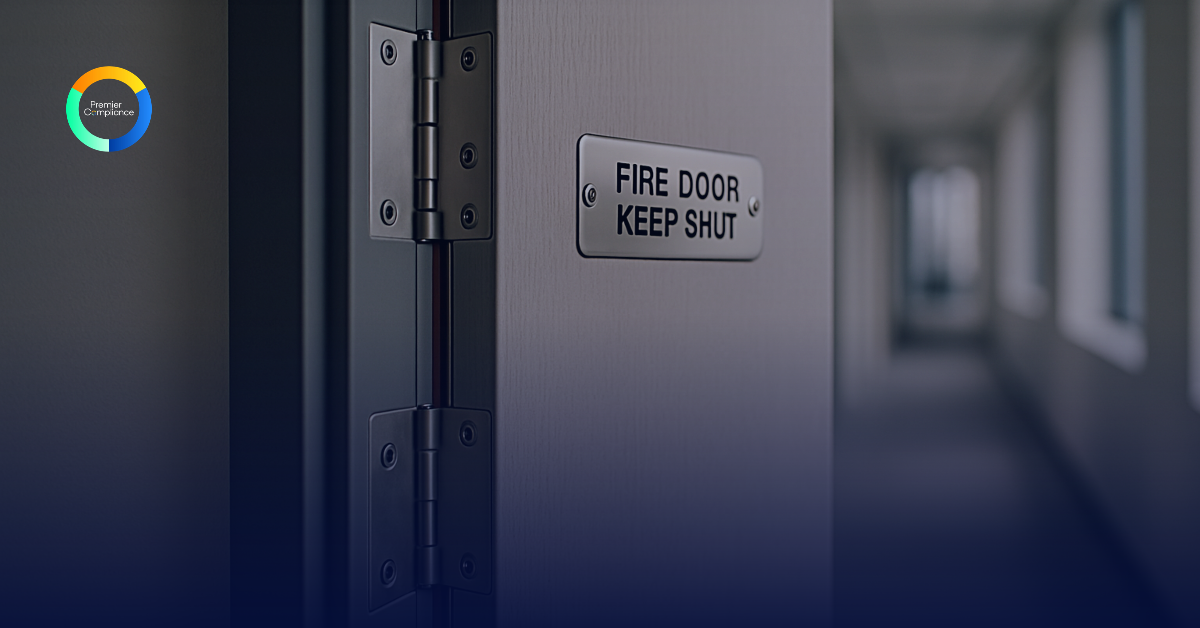
What the August 2025 update on fire doors said
Fire door guidance moves quietly. There is rarely a single announcement that changes everything overnight — instead, the expectations creep upward through updated guidance, enforcement patterns and the accumulated weight of case law and regulation. If you are a responsible person, the danger is assuming that because your building passed an inspection two years ago, your fire doors are still compliant today. They may not be.
This post sets out what the current position on fire doors means in practice, and what you should be doing about it.
The duties haven't changed — but the scrutiny has
The core legal framework is still the same. The Regulatory Reform (Fire Safety) Order 2005 makes the responsible person accountable for fire safety in the common parts of a building. The Fire Safety (England) Regulations 2022, which came into force in January 2023, added specific, non-negotiable duties around fire doors in residential buildings containing two or more flats.
For those buildings over 11 metres in height, measured to the top storey, regulation 10 requires:
- Quarterly checks of fire doors in the common parts.
- Annual checks of flat entrance doors, so far as is reasonably practicable.
None of that is new. What has shifted is how seriously these duties are being taken. Enforcement bodies are looking more closely at whether checks are actually happening, whether they are recorded properly, and whether faults identified in those checks are being put right rather than logged and forgotten.
"So far as is reasonably practicable" is not a loophole
A common misreading of the flat entrance door duty is that "so far as is reasonably practicable" gives you an easy out. It does not. The phrase acknowledges that you cannot force entry into someone's home, but it still expects you to make genuine, repeated and documented efforts to gain access.
If a resident refuses access, that refusal needs to be recorded, followed up, and escalated appropriately. One knock on the door and a shrug is not a defence. The question an inspector will ask is: what did you actually do to try?
A check is not an inspection
There is an important distinction that trips people up. The quarterly and annual checks required by the regulations are visual, condition-based assessments — is the door closing properly, are the seals intact, are there gaps around the frame, is the door leaf damaged, are the hinges sound?
These checks can be carried out by a competent person who knows what to look for. They are not the same as a detailed fire door inspection or survey, which examines the door as a complete fire-resisting assembly and considers whether it still meets its performance rating.
Both have value. The regular checks catch the day-to-day deterioration that undermines a door's performance — a wedged-open door, a missing intumescent strip, a badly fitted replacement. The deeper inspection catches the things a routine check misses. Relying only on the light-touch checks, without ever looking harder, is a gap that comes back to bite you.
The things that actually fail fire doors
In practice, fire doors rarely fail because the door leaf itself has stopped resisting fire. They fail because of small, avoidable problems that accumulate:
- Gaps that are too wide. The gap around the door leaf matters. Excessive gaps let smoke and fire through.
- Damaged or missing seals. Intumescent strips and cold smoke seals are what make the assembly work. If they have been painted over, stripped out or never fitted, the door will not perform as tested.
- Doors that don't close fully. A fire door held open, or one that fails to shut and latch because of a faulty closer, is not a fire door at all.
- Inappropriate alterations. Cut-outs for cat flaps, letterboxes, glazing or extra locks can void the door's fire performance if they weren't part of the tested specification.
- Poorly matched components. A certified door leaf fitted with the wrong frame, hinges or hardware is no longer a certified assembly.
These are the issues your checks should be catching, and the ones that should be feeding into a repair programme rather than sitting on a list.
What a responsible person should be doing now
If you are unsure whether your building is where it needs to be, work through the basics:
- Confirm the regime is running. Are the quarterly and annual checks actually being done, on schedule, and recorded? Gaps in the record are gaps in your defence.
- Check the records are usable. A meaningful record shows what was checked, by whom, when, what was found, and what was done about it. A tick-box with no follow-up is close to worthless.
- Close the loop on faults. Every fault identified should have an action, an owner and a timeframe. Identifying a problem and doing nothing about it is arguably worse than not looking.
- Know your access position. For flat entrance doors, have a documented process for requesting, chasing and escalating access — and evidence that you follow it.
- Get the deeper look done. Supplement your routine checks with a competent, detailed inspection so you understand the true condition of your doors as complete assemblies.
The bottom line
There is no single dramatic change to react to. The direction of travel is what matters: fire doors are expected to be checked properly, recorded honestly and repaired promptly. The responsible person who can show a working, documented regime — checks happening, faults fixed, access chased — is in a strong position. The one relying on a survey from years ago, or a folder of unactioned checklists, is not.
If you are not confident your fire door regime would stand up to scrutiny, that is the thing to address now, not after an incident or an inspection forces the issue.