




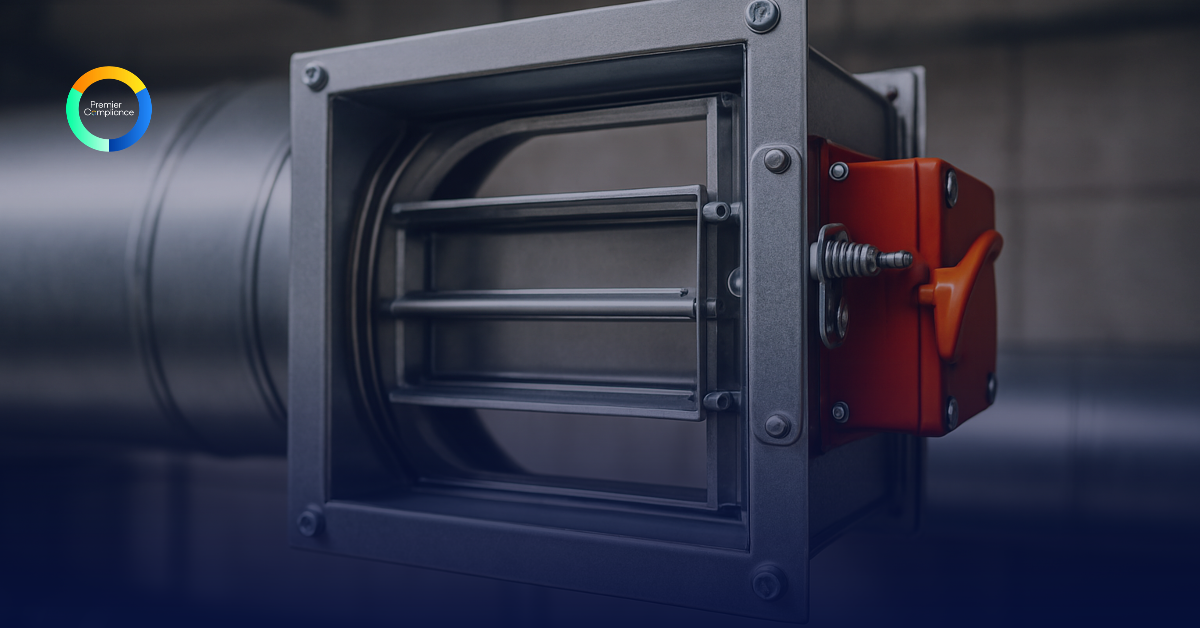
The failure you never see
A fire damper sits inside a duct, behind a grille or above a ceiling, and does nothing for years at a time. That is exactly the point. It stays open so air can move, and it closes only when heat trips it — sealing the duct so fire and smoke cannot travel from one compartment into the next. Because it does nothing visible in normal use, a jammed or blocked damper looks identical to a working one until the day it is needed. By then it is too late to find out.
The Regulatory Reform (Fire Safety) Order 2005 puts the duty on you, the responsible person, to keep fire safety provisions in efficient working order. Fire dampers are one of those provisions. Below are the faults that inspectors find over and over, and why each one matters.
1. It's painted, rusted or seized in the open position
The single most common finding. A spring-loaded or fusible-link damper relies on moving parts. Over years, corrosion, grease from kitchen extract, or a well-meaning decorator with a paint roller can lock the blades solid. A drop test — releasing the mechanism to confirm the damper actually closes — is the only way to prove it still works. A visual inspection alone tells you nothing about whether the blades will move.
2. It can't be reached to be tested
A damper that cannot be accessed cannot be tested, and an untested damper cannot be signed off as compliant. Plasterboard fixed straight over the access point, ductwork boxed in during a refurbishment, or a heavy suspended ceiling with no hatch all produce the same result: the engineer arrives, cannot get to the damper, and you receive a report full of gaps rather than results. DW/145 sets out that dampers must be installed so they can be inspected and maintained. If yours can't, that is a defect in its own right, not just an inconvenience.
3. Debris and grease build-up inside the duct
A damper cannot close against a duct full of dust, insulation offcuts or accumulated kitchen grease. In extract systems serving commercial kitchens this is a live fire risk on its own — the grease is fuel. TR/19 covers the cleaning standard for ventilation and extract ductwork, and a damper sitting in a filthy duct will neither close cleanly nor form the seal it was designed to form.
4. Wrong installation — the tek screw problem
Dampers are frequently fixed into position in a way that stops them working. Screws driven through the damper casing into the blade path, incorrect retaining angles, or a damper installed the wrong way round in the airflow all prevent proper closure. A damper only performs to its fire rating if it is installed exactly as tested. A unit rated for two hours means nothing if it has been fitted in a manner the manufacturer never certified.
5. It isn't sealed into the compartment wall
The damper and the wall it passes through are meant to work as one barrier. If the gap around the damper sleeve has been left open, or filled with ordinary expanding foam rather than a tested fire-stopping system, fire simply travels around the damper through the hole in the wall. The damper can be in perfect working order and the compartment line still fails.
6. No record it was ever tested
A damper with no paperwork is, for compliance purposes, a damper that has not been tested. You cannot demonstrate you have met your duty without records showing what was inspected, when, by whom, and what the result was. Missing or vague reports are one of the quickest ways an audit or an insurer's review turns against you.
A scenario worth recognising
A facilities manager for a mixed-use block took over an existing maintenance contract and assumed the dampers were covered. When a survey was finally commissioned, twelve of the nineteen dampers could not be reached at all — boxed in during a fit-out three years earlier — and of the seven that could be tested, two were seized solid with paint. None of this appeared in any handover document. The building had passed through two ownerships in that time with the same blind spot carried forward.
What to do about it
Commission a drop test of every accessible damper on a documented programme, not a visual glance. Where dampers can't be reached, treat that as a defect to be resolved with proper access panels — don't let it sit as a permanent gap. Keep the reports, including the ones that record faults, because the record of a problem found and fixed is exactly what proves you are managing the risk. A damper you have never tested is not protecting you. It is a question you haven't answered yet.